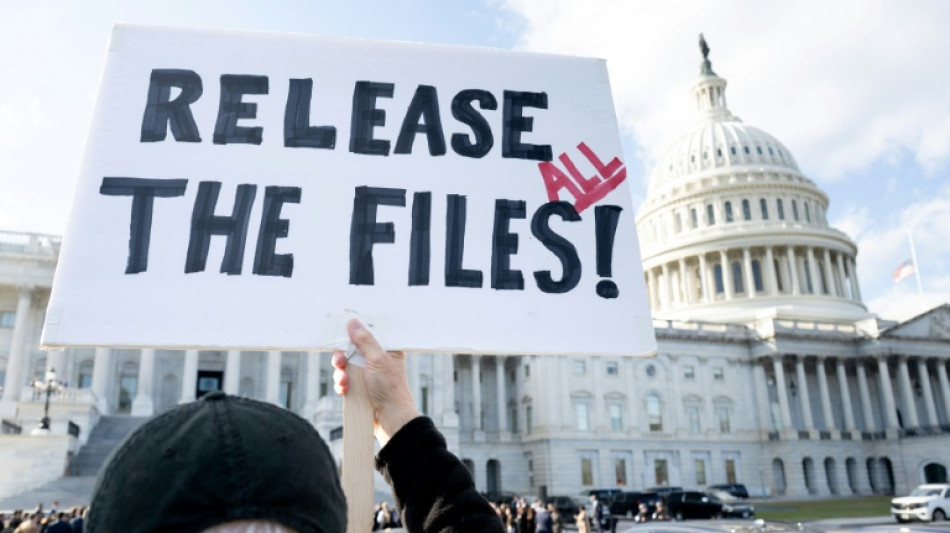
Epstein files due as US confronts long-delayed reckoning / Photo: © AFP/File

The United States is poised on Friday to pry open one of its most closely guarded case files, as President Donald Trump's administration prepares to release a long-suppressed cache of records tied to convicted sex offender Jeffrey Epstein.
Mandated by the Epstein Files Transparency Act, the disclosure forces the Justice Department (DOJ) to confront years of secrecy surrounding the late financier's alleged sex trafficking operation -- a case that has become shorthand for accusations of elite protection and systemic failure.
"We do expect compliance," House Democratic Minority Leader Hakeem Jeffries told reporters.
"But if the Department of Justice does not comply with what is federal law at this point, there will be strong bipartisan pushback."
For the public and for survivors, the publication marks the clearest opportunity yet to shed light on a scandal that continues to convulse America.
Advocates, however, caution that the government may cite legal constraints to obscure critical facts.
For Trump, the moment carries enormous personal and political sensitivity.
Epstein, who died in custody after his 2019 arrest, spent decades embedded in rarefied circles in which he cultivated relationships with wealthy politicians, academics and celebrities while, prosecutors say, he trafficked hundreds of girls and young women.
Trump and his allies have repeatedly claimed that prominent Democrats and Hollywood figures were protected from accountability, framing the Epstein scandal as proof that money and influence can subvert the justice system.
But the president himself once counted Epstein among his social companions, as the two circulated in the same Palm Beach and New York milieus in the 1990s and appeared together at parties for years, before Trump later said their relationship soured.
After returning to office, and acquiring the unilateral authority to publish the files, Trump dismissed the years-long push for transparency that he had once encouraged as a "Democrat hoax."
He fought Congress over its drive to get the records out in public, but relented and signed the Epstein files act once a sweeping bipartisan consensus made opposition untenable.
- Hopeful but guarded -
The newly released records could clarify how Epstein operated, who assisted him and whether prominent individuals benefited from institutional restraint.
Survivors say they are hopeful but guarded, pointing to Trump's evolving positions on the issue.
The president severed ties with Epstein years before the 2019 arrest and is not accused of wrongdoing in the case.
The law requires the unsealing of extensive internal correspondence, investigative files and court documents that have previously remained sealed or inaccessible.
They may reveal new associates and clarify why prosecutors stalled for years, but expectations of a definitive "client list" are likely misplaced, with the Justice Department saying no such roster exists.
The statute restricts disclosure of records that could identify victims, compromise ongoing investigations or endanger national security -- granting prosecutors wide latitude to redact names, classified intelligence and legally sensitive material.
Observers anticipate substantial redactions, though the law explicitly bars censorship on grounds of "embarrassment" or "political sensitivity."
Trump has recently ordered investigations into Democrats linked to Epstein, prompting speculation that those inquiries could be cited as justification for withholding records.
The case remains combustible because it sits at the crossroads of immense wealth, political influence and perceived impunity.
Epstein amassed powerful allies, maintained luxury properties where abuse allegedly occurred and secured a hugely contentious 2008 plea deal in a separate case that critics say may have protected unnamed co-conspirators.
His subsequent arrest -- followed by his death in a New York jail, officially ruled a suicide -- reignited questions over how such conduct persisted for years with limited accountability.
"The truth is that we don't know what the DOJ is going to do... But they have a chance to do the right thing, and they should take it," Robert Garcia, the top Democrat on the House Oversight Committee, posted on X.
"RELEASE THE FILES."
V.Duran--ESF