After Cuba beckons, Miami entrepreneurs are mostly reluctant to invest in the island / Photo: © AFP

Havana announced this week that it would allow Cuban emigrants to invest to address the communist island's severe economic and energy crises. But in Miami, the epicenter of the diaspora, entrepreneurs are generally reluctant.
"I don't think a single businessman, not a single Cuban in exile, will invest in this island where there is no legal security," said Ivan Herrera, director of the Univista insurance company, calling the initiative "a huge scam."
The entrepreneur, whose grandfather was a political prisoner for 12 years before fleeing to Miami, refuses to invest under what he calls the "criminal" government.
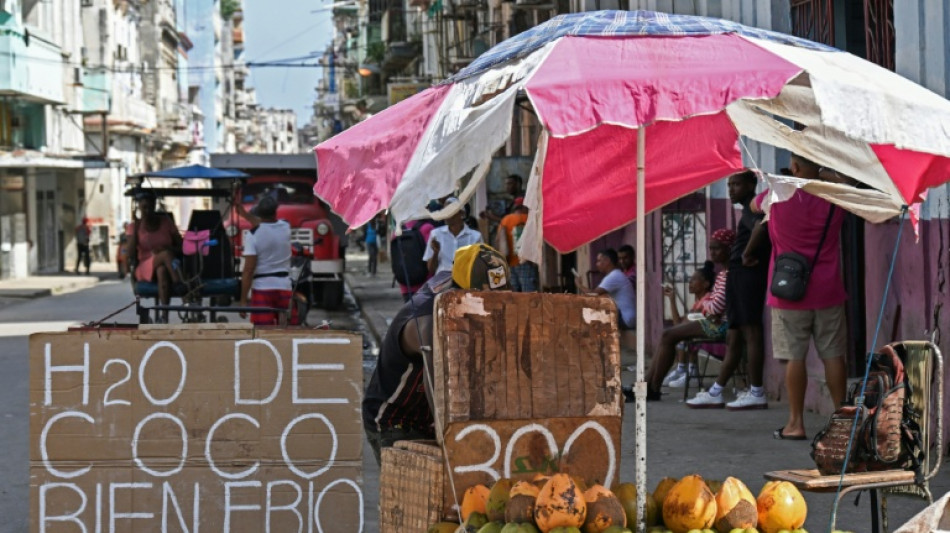
This opening by Havana, a serious breach in the island's anti-capitalist system, comes as the Cuban economy teeters on the brink of collapse. The shortage of essential goods is worsening daily, and power outages have multiplied since President Donald Trump's administration cut off Venezuelan oil supplies.
Carlos Saladrigas, president of the human resources company Regis HR Group and the think tank Cuba Study Group, viewed the move as a step in the right direction, but said that Cuban authorities needed to resolve many unanswered questions to attract investment.
"Reintegrating the diaspora into the country's economic life is essential for Cuba's future," he said.
"But behind their words lies an entire legal framework that needs to be reformed," Saladrigas said.
"The government has to say: 'We are going to discard traditional socialism and a centrally planned economy and adopt market-based measures.'"
- ‘Extremely risky’ -
Hugo Cancio, owner of the digital media outlet OnCuba and Katapulk, an online supermarket that allows the purchase and delivery of products in Cuba, was more enthusiastic.
"Of course I would invest in Cuba, and I would do so with great pleasure," he said. "Do you know why? Because it's not just an investment; I would be helping to rebuild my country."
But Pedro Freyre, a Cuban-American lawyer specializing in the island's regulatory framework, considers Cuba an "extremely risky" investment destination.
He justified this view by citing a dysfunctional banking system, a highly unstable currency, the absence of the rule of law guaranteeing private property, the failure of the centrally planned economy, and "completely dilapidated" infrastructure.
"It’s very difficult to say to yourself, 'I'm going to take the money I've saved my whole life to open a McDonald's on the Malecon (Havana's famous seaside promenade) when I don’t know if there's electricity, water, or if the Malecon is going to collapse into the sea,'" he said.
Adding to these obstacles is the fact that, under the American embargo imposed since the 1960s, Washington must allow its residents to conduct business on the island.
Herrera hoped to be able to invest "when there is a free Cuba," to support his compatriots who lack housing, infrastructure, sanitation, and electricity.
"Here in Miami, people and very large companies built the city while we arrived with nothing," he said. "In the same way, we can build and rebuild Cuba."
P.Avalos--ESF