Trump again threatens Iran infrastructure as he orders negotiators to Pakistan / Photo: © US Central Command (CENTCOM)/AFP

US President Donald Trump said he was sending a delegation to Pakistan on Monday for negotiations with Iran, while renewing his threats to destroy the country's vital infrastructure if it didn't agree a deal.
"NO MORE MR. NICE GUY!" the American leader declared on Sunday in a post on his Truth Social account, saying that without a deal, Washington was "going to knock out every single Power Plant, and every single Bridge, in Iran".
Iran and the United States, along with Israel, are three days away from the end of a two-week ceasefire that halted the Middle East war started by surprise US-Israeli strikes on Iran on February 28.
There has so far been only a single, 21-hour negotiating session held in Islamabad on April 11 that ended inconclusively, though groundwork for fresh talks continued afterwards.
"We're offering a very fair and reasonable DEAL, and I hope they take it," Trump said in his post.
No date has yet been announced for a second round of talks, and Iran's speaker of parliament and senior negotiator Mohammad Bagher Ghalibaf insisted on Saturday night that the two sides were "still far from the final discussion".
Trump justified the war as an attempt to stop Tehran acquiring nuclear weapons -- an ambition it has always denied -- and the atomic issue remains a key sticking point in negotiations.
Iran and the US had already been discussing Tehran's nuclear programme in Omani-mediated talks when Washington launched the war, which has now added a fresh point of contention -- the Strait of Hormuz, a chokepoint for oil and gas shipments that Iran has ordered closed.
- Heightened security -
In Islamabad, security had been visibly stepped up on Sunday ahead of the expected talks.
Authorities announced road closures and traffic restrictions across the city, as well as in neighbouring Rawalpindi.
AFP journalists saw armed guards and checkpoints near Islamabad's most secure hotels -- the Marriott and the Serena.
"Citizens are earnestly requested to cooperate with the security agencies," a city official posted on X.
The US president said his negotiators, whom he didn't name, would arrive in the Pakistani capital on Monday evening.
The previous delegation was led by Vice President JD Vance and included Middle East envoy Steve Witkoff, who led the aborted pre-war talks.
A major sticking point of negotiations has been Iran's stockpile of near-weapons-grade enriched uranium.
Trump said on Friday that Iran had agreed to hand over its roughly 440 kilogrammes of enriched uranium. "We're going to get it by going in with Iran, with lots of excavators," he said.
But Iran's foreign ministry has said the stockpile, thought to be buried deep under rubble from US bombing in last June's 12-day war, was "not going to be transferred anywhere", and surrendering it "to the US has never been raised in negotiations".
On Sunday, President Masoud Pezeshkian questioned why Iran should give up its "legal right" to a nuclear programme.
- Hormuz closed again -
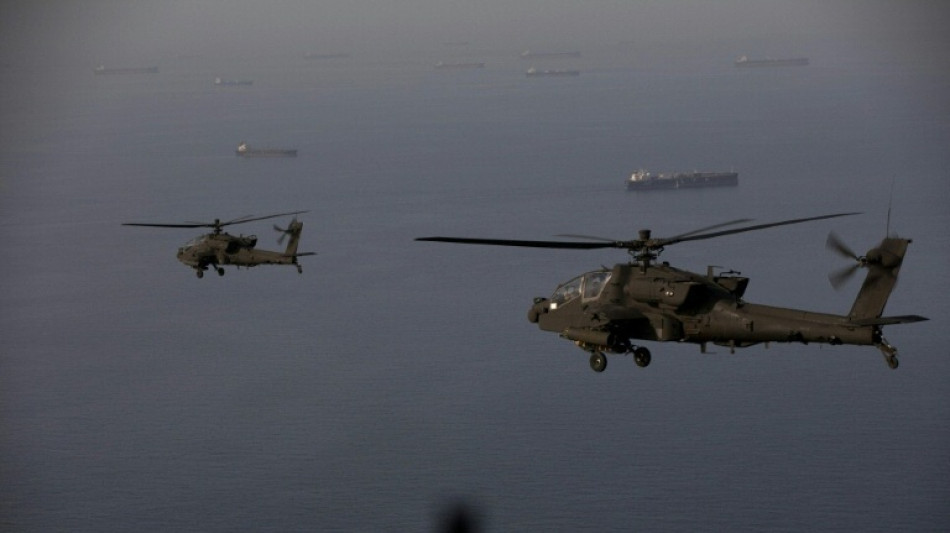
Tehran moved to close off the vital Strait of Hormuz, through which a fifth of the world's oil and liquefied natural gas travel in peacetime, at the start of the war, hammering the global economy and roiling markets.
Having failed to force it open again, Trump countered with a US naval blockade on Iranian ports in an attempt to cut off Tehran's oil revenues.
Iran briefly reopened the strait on Friday in recognition of an Israel-Hezbollah ceasefire in Lebanon, but closed it again the following day in response to the US maintaining its blockade.
Iran's Revolutionary Guards warned that any attempt to pass through the strait without permission "will be considered cooperation with the enemy, and the offending vessel will be targeted".
"If America does not lift the blockade, traffic in the Strait of Hormuz will definitely be limited," Ghalibaf said.
Iranian foreign ministry spokesman Esmaeil Baqaei on Sunday said the blockade was "a violation" of the ceasefire" and illegal collective punishment of the Iranian people.
A handful of oil and gas tankers had crossed the strait early on Saturday during the brief reopening, but by early Sunday morning tracking data showed the waterway empty of shipping.
The afternoon before, a trio of incidents demonstrated the dangers of any attempted crossing.
A UK maritime security agency said the Revolutionary Guards fired at one tanker, while security intelligence firm Vanguard Tech reported the force had threatened to "destroy" an empty cruise ship that was fleeing the Gulf.
In the third incident, the UK agency said it received a report of a vessel "being hit by an unknown projectile, which caused damage" to shipping containers but no fire.
Trump said of the incidents: "That wasn't nice, was it?"
burs-dcp/smw
P.Avalos--ESF