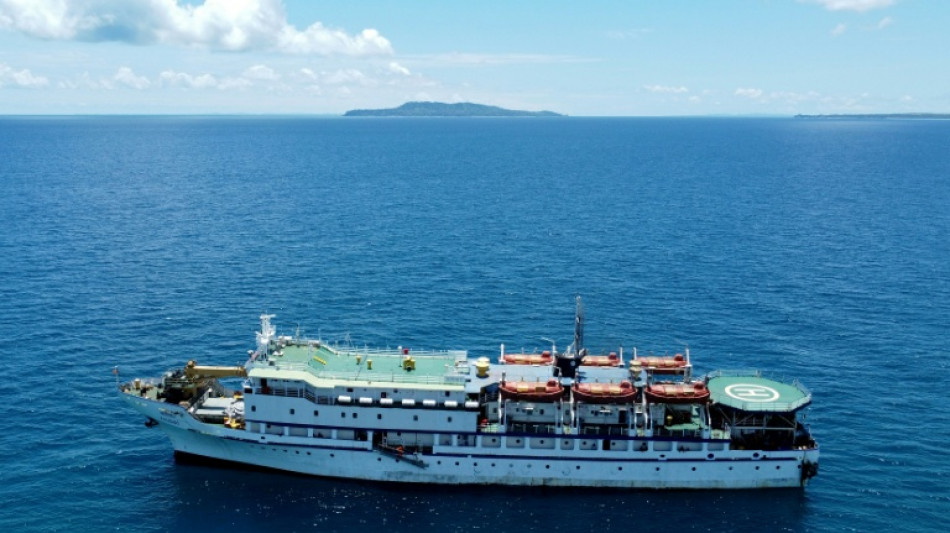
India's lifeline ferry across strategic archipelago / Photo: © AFP

Leaping from a small boat in choppy waters off India's Andaman and Nicobar Islands, George Washington jumps on board the only ferry service connecting hundreds of communities across the strategic archipelago.
"These ships are a lifeline for the people," 18-year-old Washington told AFP, travelling between two tiny green specks in the 800-kilometre-long (500-mile) Indian Ocean chain, from Chowra to the slightly larger Car Nicobar.
"If I had missed this one, I'd have to wait for the next one for a few days," Washington said, after clambering onboard the government-run MV Kalighat, an 85 metre-long (278 foot) cargo and passenger vessel.
Washington's journey lasted about five hours on the ferry service that takes up to 50 hours from end to end.
Running from the archipelago's capital Sri Vijayapuram in the north to the southern tip of Campbell Bay, the ferry serves as both a passenger and cargo ship linking the 836-island archipelago.
At each stop, passengers like Washington or others laden with sacks of coconuts or pineapples for the market get on and off.
At bigger ports, a few cargo containers are loaded or unloaded.
Many islands like Chowra -- a three-kilometre-long (two-mile) forest speck in a vast blue sea -- lack deep-water jetties.
So passengers must reach ocean-going ferries by smaller tenders.
Recalling one such journey, islander Tony Usman said "it was very scary", as the poor weather made the transfer from a small boat to the ferry treacherous.
"I hope that more ships are added and the jetty too is expanded, which is in a bad state," said Usman, 15, who was also travelling from Chowra to his home at Car Nicobar.
India hopes to change that soon.
- 'Touch every island' -
As part of a $9-billion plan, New Delhi is building a megaport, an airport and city on the Great Nicobar island, at the southern end of the archipelago.
The colossal construction is projected to expand the population and bring tourists to the archipelago, located more than 2,500 kilometres (1,555 miles) from India's mainland.
New Delhi sees development there as a way to counter China's growing regional influence.
Giant container ships ply sea lanes skirting the archipelago's southern tip, where roughly a third of global maritime trade transits between Asia, Africa, the Gulf and the Red Sea.
Vijay Kumar, the archipelago's director of shipping, said port facilities would be upgraded and new vessels deployed within two years.
"We are going to augment facilities -- either by reconstruction, or construction of new jetties," he said, underlining that his service's mandate is to "touch every island".
"We shall line up 10 plus new vessels for the region."
For now, the slow ferry remains the main form of long-distance transport serving the archipelago's estimated 420,000 residents, as government-run helicopters remain out of reach for most.
Passengers bring their own food or distraction for their long trips, with some playing carom -- a popular board game -- to pass the time, while goats tied up at a corner graze on a handful of hay.
Harjinder Pal Kaur, 66, says the ferry has already come a long way from the 1970s, when she settled on the Great Nicobar island.
At that time, there was only one boat a month, and the journey took up to six days without any air conditioning, while passengers today can pay for more comfortable sleeping cabins.
"We spent so many months with no fresh rations as the ships failed to reach here, or the limited vegetables they were carrying were spoiled during the long journey," she recalled.
Kalighat crew member Vincent Soreng said the journeys offer a rare window into island life.
"You learn so much about life observing all the people and hearing their stories along the way," Soreng said.
M.Rubio--ESF